

Just Accepted
Just Accepted Articles have been posted online after technical editing and typesetting for immediate view. The final edited version with page numbers will appear in the Current Issue soon.
Submit a Manuscript

Tuning the d-band center of amorphous NiCo alloy via P doping for enhanced urea electrolysis
Wenjie Jiang, Jiali Lu, Jia Wu, Boyao Feng, Zhixiang Zhai, Huan Wen, and Shibin Yin*
https://doi.org/10.1016/j.cjsc.2026.100865
Phosphorus doping; Amorphous NiCo alloy; Reactant adsorption; Urea oxidation reaction; Hydrogen evolution reaction
ABSTRACT
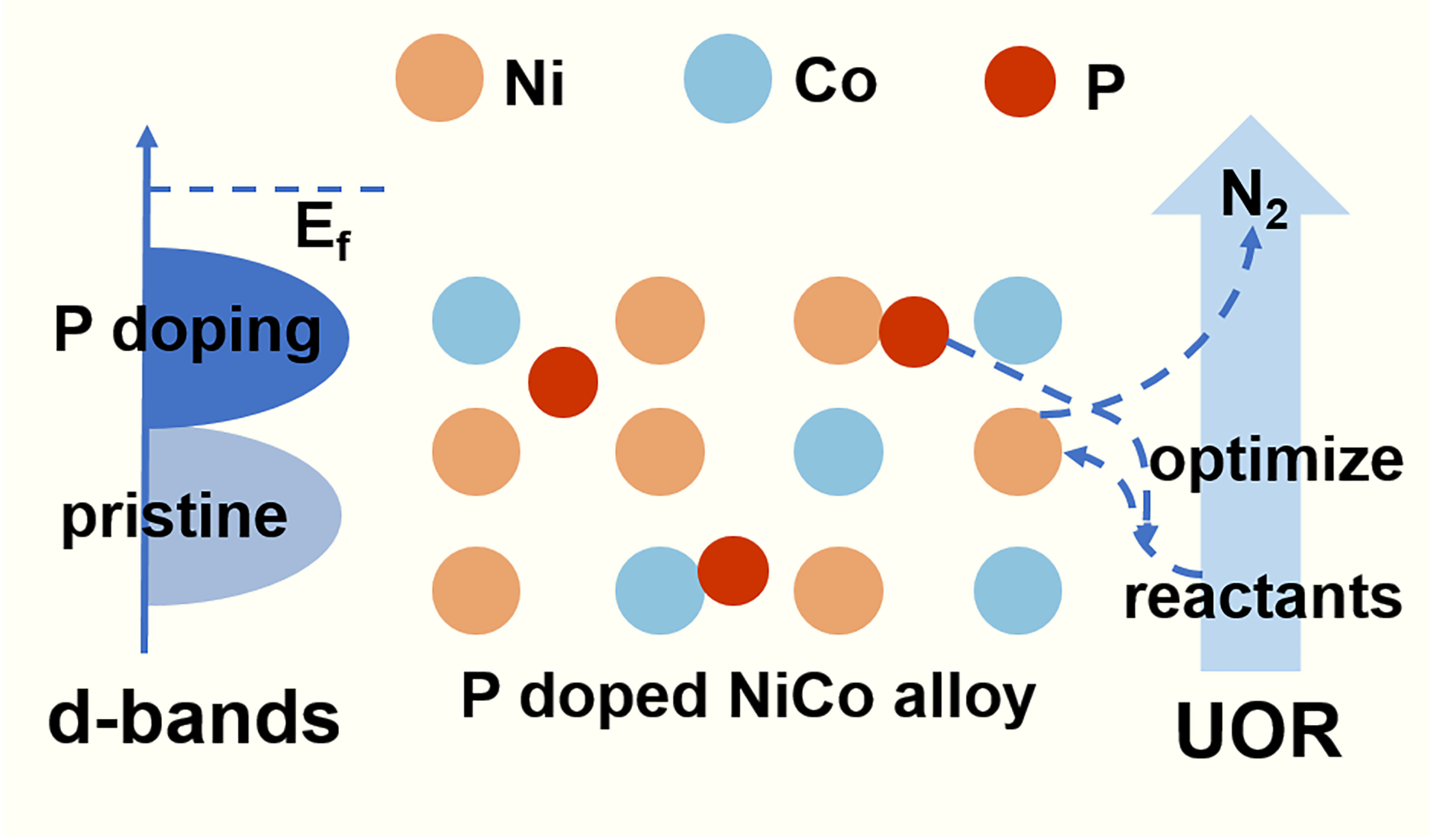
Nickel-cobalt (NiCo) alloys with bimetallic electronic modulation are considered promising candidates for urea electrolysis. However, their highly occupied?d-band states limit the adsorption of reaction intermediates, resulting in insufficient activity toward urea oxidation reaction (UOR) and hydrogen evolution reaction (HER). Herein, a phosphorus-doped amorphous NiCo alloy is synthesized, in which P incorporation modulates the electronic structure and upshifts the?d-band center of NiCo alloy, thus optimizing the adsorption of OH??and urea molecules. The sample with optimal P content exhibits low potentials for UOR (E10/1000?= 1.28/1.65 VRHE) and HER (E?10/?1000?= ?67/?206 mVRHE). Furthermore, it achieves an industrial-level current density of 500 mA cm?2?at a cell voltage of 1.72 V in the membrane electrode assembly, while maintaining stable activity for 150 h. Therefore, this work provides a new strategy to optimize reactant adsorption and ultimately enhance the electrocatalytic activity by modulating the?d-band center.



- Address: Fuzhou High & New Technology Industrial Zone, Shangjie, Minhou, Fuzhou, Fujian 350108, China
- Tel: (86)-591-63173769, 63173770
- E-mail: cjsc@fjirsm.ac.cn
CN 35–1112/TQ, ISSN 0254–5861, Online ISSN: 2949-768X Copyright @ 2022 Chinese Journal of Structural Chemistry-www.Chinese Journal of Structural Chemistry.net. All Rights Reserved 閩ICP備2022002645號-1